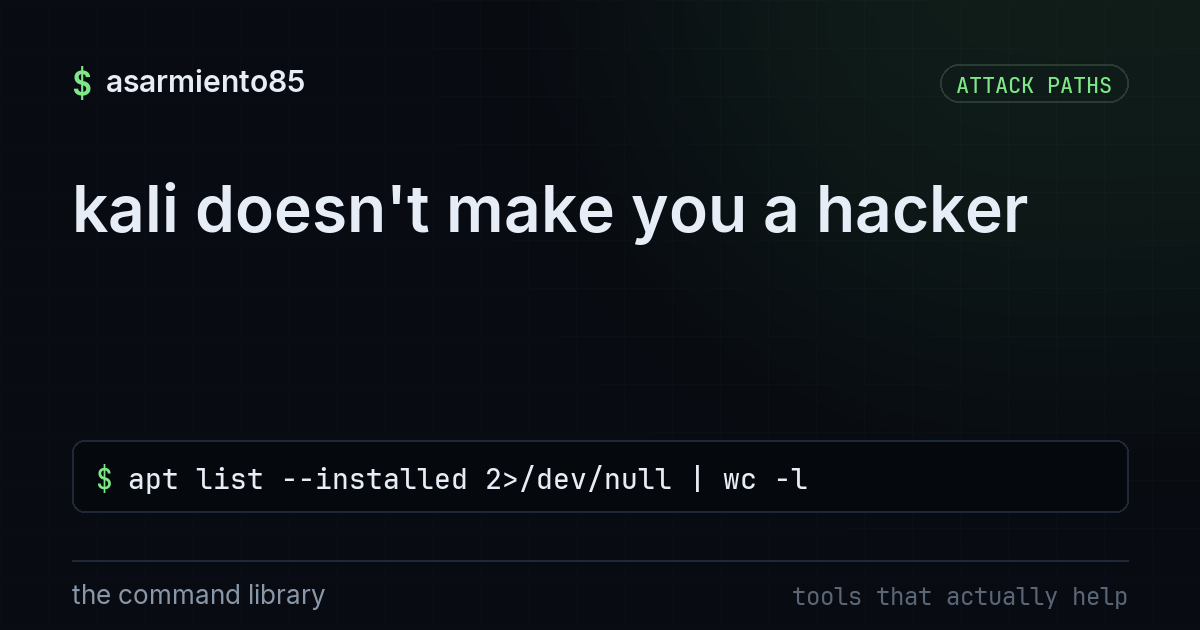
kali doesn't make you a hacker
apt list --installed 2>/dev/null | wc -linstalling kali doesn't make you a hacker
buying a scalpel doesn't make you a surgeon. buying a guitar doesn't make you a musician. and installing kali linux doesn't make you a hacker, it makes you someone with a laptop full of tools you probably don't know how to use yet. the operating system is not the skill. the operating system is just a toolbox somebody else organized for you.
this matters more than people think, especially if you're new to security. a lot of folks install kali, see a folder full of scary-sounding tools, and think proximity to the tools equals competence. it doesn't. let's break down a dead simple command that proves the point.
the command
apt list --installed 2>/dev/null | wc -lthis just counts how many packages are installed on your linux box. that's it. no magic, no exploit, no "hacker" energy at all. it's inventory management.
breaking it down piece by piece
apt list --installed asks your package manager to print every package currently installed on the system. on debian based distros like kali or ubuntu, this is the same tool you'd use to check if your software is up to date.
2>/dev/null redirects stderr, the error output, into the void. apt likes to print a warning that says "this command is not intended for scripting" and honestly it's annoying, so this just silences that noise so you get a clean list.
| wc -l pipes that list into word count with the line flag, which counts how many lines came through. since each installed package is its own line, you get a total package count.
run it yourself and you'll probably see a number somewhere between 1,500 and 4,000 depending on your distro. kali ships heavy because it's built for a specific job. that job is not "make you dangerous by default," it's "have the tools ready when you already know what you're doing."
why the tool count doesn't equal skill
here's the actual point of the reel. kali comes preloaded with tools like nmap, metasploit, burp suite, hydra, and dozens of others. none of those tools do anything on their own. nmap doesn't know what a network is until you point it at one and understand what the output means. metasploit doesn't pop a shell because you clicked something, it requires you to understand the vulnerability you're targeting, why it exists, and what the exploit actually does under the hood.
the number from that command you just ran, that's not a skill score. you could have 4,000 packages installed and still not understand tcp handshakes, how ports work, or what a cve even is. skill comes from understanding fundamentals, not from package count.
what this means for defenders
flip this around, because that's really what this brand is about. if a random laptop shows up on your corp network running kali or a similar pentest distro, the tool count itself is not the threat signal you should care about. what matters is behavior. is something scanning your subnet at 3am. is there unusual outbound traffic to weird ports. is someone running credential stuffing against your login page.
you can actually use this exact kind of package audit on your own systems as a hygiene check. know what's installed on your machines. an unusually bloated system, or one with tools you don't remember installing, is worth investigating. run something like this periodically:
apt list --installed 2>/dev/null > installed_$(date +%F).txtsave a snapshot, compare it over time. if new packages show up that you didn't install, that's a lead worth chasing, not paranoia.
the takeaway
the os doesn't make the hacker, and it doesn't make the threat either. understanding what's running on your systems, why it's there, and what normal looks like for your environment, that's the actual skill and the actual defense. tools are just tools. knowing your own baseline is what protects you.